RNA: Next Frontier of Small Molecule Drug Discovery
Serna Bio is building the next generation of small molecules to enable precision control of protein expression.
Since our 2023 landscape analysis, the RNA-small molecule field has matured but with a bottleneck: most clinical-stage programs are merely Risdiplam analogues.
Serna Bio takes a different path. We have bypassed derivative chemistry to unlock entirely new chemical space. Our engine, fueled by over 3 million proprietary RNA-small molecule interactions and 200,000+ druggable RNA structures, powers our platform to identify selective, functional modulators where others struggle. We are not just following the trail; we are charting a new one.
Why RNA? Moving Beyond the Proteome
Traditional small molecule discovery has been remarkably successful, but it has been optimized around a relatively narrow class of targets: proteins with binding pockets that can accommodate drug-like molecules.
This leaves a substantial amount of human biology difficult to access.
At Serna Bio, our hypothesis is that by targeting RNA, we can use small molecules to modulate biology in ways that have historically been difficult or impossible.
That includes:
- Translation enhancement: increasing protein production to address diseases driven by insufficient protein expression.
- Translation inhibition: reducing the production of pathogenic proteins.
- Splice modulation: changing RNA processing to restore or redirect functional protein expression.
This creates the possibility of a more precise, tunable approach to controlling protein expression.
Not simply on or off.
More like a dial.
Drug discovery has been optimized around the proteome. The next frontier is the transcriptome. We are redefining the small molecule target space by shifting the paradigm from the proteome to the transcriptome.
Why Do We Believe in Small Molecules?
New therapeutic modalities offer tremendous potential. Gene therapies can address the underlying cause of disease. Antisense oligonucleotides and siRNA have demonstrated the power of directly manipulating RNA. Biologics have transformed the treatment of cancer, autoimmune disease and many other conditions.
But every modality has constraints.
Delivery remains a fundamental challenge
Large molecules often struggle to reach all tissues and cell types effectively. Crossing biological barriers, achieving intracellular delivery and maintaining sufficient exposure can require complex delivery technologies.
Manufacturing remains complex and expensive
Many advanced therapeutic modalities require sophisticated manufacturing and distribution infrastructure. Their cost can create significant challenges for healthcare systems, particularly for chronic diseases or large patient populations.
Accessibility matters
This is discussed far less often than efficacy or scientific novelty, but it is equally important.
A medicine is only transformative if patients can access it.
Small molecules remain uniquely scalable. They can often be manufactured at relatively low cost, distributed globally, formulated as oral medicines and used without highly specialized clinical infrastructure.
For a large proportion of the world's population, particularly outside high-income healthcare systems, scalable small molecules may be the only therapeutic modality that can realistically achieve broad access.
When given the option, patients prefer an oral small molecule. Recent studies have shown that when given a choice, patients prefer once daily oral medications vs an injectable. This is particularly true for CNS indications, where genetic medicines require an intrathecal injection. This is evident when looking at Spinraza vs Evyrsadi (risdiplam) for SMA. While Spinraza (ASO) was first to market, Evryrsadi has taken significant market share.
The future of medicine should not require choosing between scientific sophistication and global accessibility. We believe RNA can enable new biology, while small molecules provide a path to delivering that biology at scale.
The Serna Bio Approach: why are we different?
Our platform is built around a simple idea: to develop a new tool kit for drug discovery, one first needs appropriate datasets. Public datasets for RNA, either structures or small molecule binding data are too small for effective computational modelling, since they have been developed for proteins.
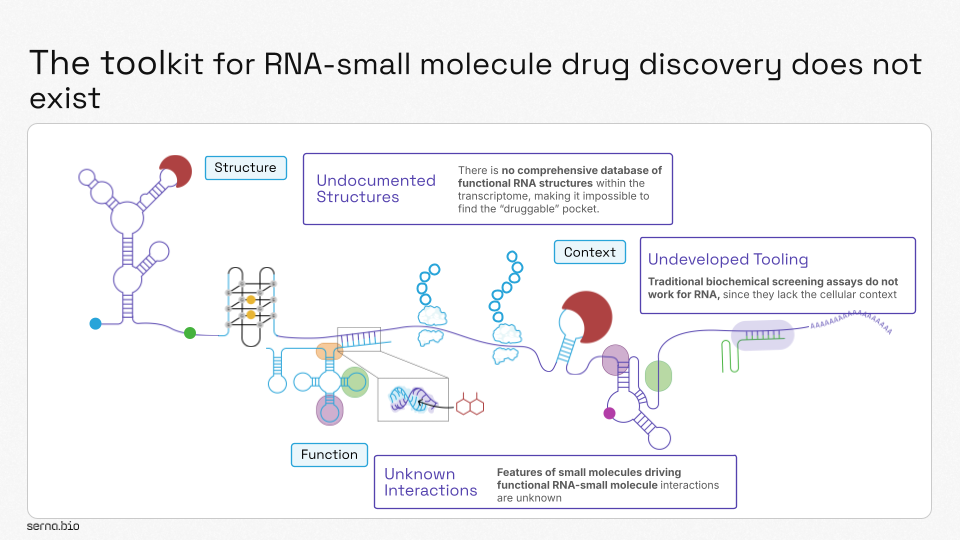
To address this, we built the data ourselves
Serna Bio has developed a proprietary atlas of 200k+ experimentally determined, druggable RNA structures and over 3 million RNA-small molecule interactions. These datasets are designed not simply to identify molecules that bind RNA, but to understand which RNA structures are functional and how chemical structure translates into biological activity.
By integrating this data with AI-driven chemistry and our RNA drug discovery platform, we can systematically explore:
- Which RNA structures are druggable.
- Which binding events are functionally meaningful.
- Which chemical features drive selectivity and activity.
- And how to optimize entirely new chemical matter against RNA.
Our goal is not to rediscover variations of the few RNA-targeting chemotypes that already exist.
It is to expand the chemical and biological space available for RNA-targeted drug discovery.
By focusing on functional RNA motifs and exploring novel chemical cores, we aim to move beyond the limitations that constrained earlier approaches to the field.
Building a Platform, Not Just a Pipeline
Our goal is not simply to discover one RNA-targeted medicine.
It is to build a platform capable of repeatedly discovering them.
That is why partnerships are central to our strategy.
RNA creates opportunities across a broad range of therapeutic areas and biological mechanisms. No single company can pursue every target or disease area where RNA modulation could create value.
We want to work with pharmaceutical and biotechnology companies that have deep expertise in specific diseases and targets, while Serna Bio brings the platform needed to determine whether those biological problems can be addressed through RNA-targeted small molecules.
The model is straightforward:
Partners bring the biology and disease expertise.
Serna Bio brings the RNA discovery engine.
Together, we can explore targets that may have previously been considered inaccessible to small molecule drug discovery.