STaR: Small Molecules Targeting RNA: Defining the Chemical Rules that Govern RNA Binders
Understanding the chemistry of RNA-binding
Learn more: Physicochemical Principles Driving Small Molecule Binding to RNA, released as a preprint on bioRxiv
The chemical characteristics of small molecules that bind RNA are poorly understood, particularly when compared to those targeting proteins. This is in part due to a disparity in data; the largest publicly available RNA-binding datasets are on the order of tens of thousands of compounds, which is orders of magnitude smaller than ChEMBL, which contains almost 3 million compounds. Frequently, primary screens for RNA targets using diversity libraries can result in zero hits, or 0.1% hit rates. Moreover, many of the compounds targeting-RNA in the public domain, other than Risdaplam, are pan-RNA binders.
Therefore, it is difficult to design libraries to enrich drug-like non-Risdaplam starting points.
At Serna Bio, we have generated a proprietary dataset of experimental RNA small-molecule binding data to unlock novel chemical space that enables precision control of protein expression. Across multiple screens, we have tested over 230,000 small molecules and generated 3 million+ data points. Our screening has been conducted across different experimental platforms and RNA structural targets to provide diversity in the hypotheses we can test and the lessons we can learn. We have followed this up with almost 10,000 compounds being tested in functional, cellular assays, providing unparalleled insight into how RNA-small molecule interactions yield tangible functional outcomes in a cellular environment.
One outcome from our evaluations of this data is physicochemical rules of thumb that can be used to define areas of chemical space enriched for RNA binders - the Small molecules Targeting RNA (STaR) rules of thumb. We developed these rules using our own data, and then assessed them using publicly available RNA-small molecule datasets (Inforna 2.0, R-BIND 2.0, DRTL, ROBIN) and found them to be widely generalizable. For emerging fields, such as RNA-targeting small molecules, the only way to learn these lessons is to gather the experimental data necessary to reveal them.
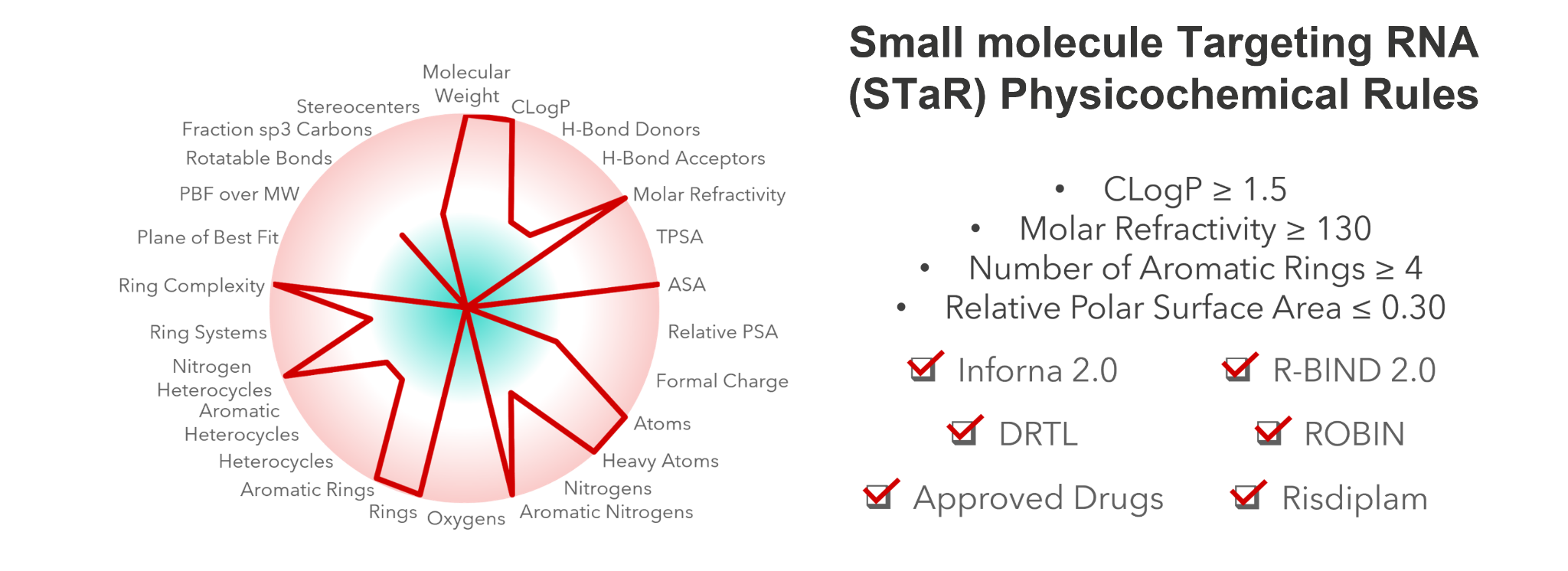
Figure: Physicochemical properties were assessed based on the Serna Bio dataset to determine which signals are associated with small molecule RNA interactions. Rules established on our data generalize to RNA-binding data from the public domain and Risdiplam.